
F.U.E.L : A feedback framework
F.U.E.L : A feedback framework
“I didn’t sleep a wink last night.”
“The faster I get this over with, the better.”
“I was a nervous wreck before the meeting him.”
“Seriously, they don’t pay me enough to do this job.”
Are these familiar thoughts you’ve had or comments you’ve made when needing to give corrective feedback? You’re not alone. In a survey by Zenger Folkman of 7,631 individuals, 44% agreed that they believed giving corrective feedback was stressful or difficult.
In a previous article, we had shared some suggestions to help the process of giving redirecting or corrective feedback. Redirecting feedback is corrective feedback that enables a recipient to build know-how or competence, purpose or motivation, or adjust behaviour.[1] It includes suggestions for doing something that hasn’t been done, ideas about improving the way something is done and recommendations to discontinue something getting in the way.
Given that most of us seem to be uncomfortable with giving redirecting feedback, we’d like to share a model that could help guide your conversation.
Brenda & Glenn
Brenda noticed Glenn was consistently making errors in the daily cumulative reports of the number of cases attended to at the centre. She wasn’t sure what had caused this. She needed to let Glenn know that the errors could not continue as it causes repercussions in staff deployment at the centre.
Framing the conversation provides an outline and focus for the conversation. It lays out the issues that will be discussed as well as the desired outcome of the conversation.
Brenda: Hi Glenn, I would like to talk to you about the daily report submission. Is this a good time?
Glenn: Sure, Brenda.
Brenda: I would like to share some observations and hear your point of view regarding the statistics in the daily reporting. At the end of the conversation, I would like us to work together on figuring out how to reduce or even eliminate the errors in the reporting.
In this step, we’re not trying to solve the issue at hand but just to understand it better. The key objective of this step is to expand the feedback receiver’s point of view of the situation.
Brenda: If I may, could I share with you what I have noticed?
Glenn: (a little apprehensive) Sure, Brenda.
Brenda: During the reporting period of the last two weeks, I have noticed that you’ve been missing out the number of cases attended to. The missing number of cases has an effect on my staff deployment scheduling process. On some days, not all, we then face a shortage of staff to attend to cases and have some clients walk away disgruntled as we were unable to attend to them. It also puts pressure on the staff on duty to close their cases quickly so they can attend to the waiting cases. We’re not sure but clients may also feel that they could have gotten more out of their time with us. If this keeps going, we may have a growing number of dissatisfied clients.
Glenn: Thanks for bringing this up, Brenda. I hadn’t realised that it affected the scheduling process.
Brenda: I didn’t think you were aware, which is why I wanted to have this conversation with you. What do you think could be causing the lapse in reporting the case numbers by two staff?
Glenn then gives an explanation.
Step 3 is where we start to look for solutions to resolve the issue that was defined in step 1. And you can jump in with how you can directly help resolve it too.
Brenda: Is this something that you would like to work on together so the whole team benefits?
Glenn: Yes, Brenda. I kinda feel lousy that I stressed the team out.
Brenda: Describe to me what a good working routine would look like for our team, Glenn.
Glenn gives a possible working routine that would work for the team, including him. Brenda encourages him on coming up with some solutions and asks what else could be explored. By doing so, Glenn is given an opportunity to explore and suggest more possible solutions. Brenda continues to encourage him and offers to support his plans.
This last step is an accountability step with specific timelines in place for specific tasks or milestones. And you naturally create a follow-up plan and check-in opportunities.
Brenda: So, what’s our next step?
Glenn is now more engaged in getting the solution/s going and lets Brenda know the next steps he needs to take to move forward. Brenda continues to be encouraging and states the action steps she can take to support Glenn’s before asking for a follow-up meeting.
Brenda: Thank you for being willing to hear the feedback and work with me on this, Glenn. When next week shall we meet again to discover if we need to finetune this machinery?
Glenn: Same time and day next week works for me.
Brenda: Okay, that works for me too.
Getting comfortable
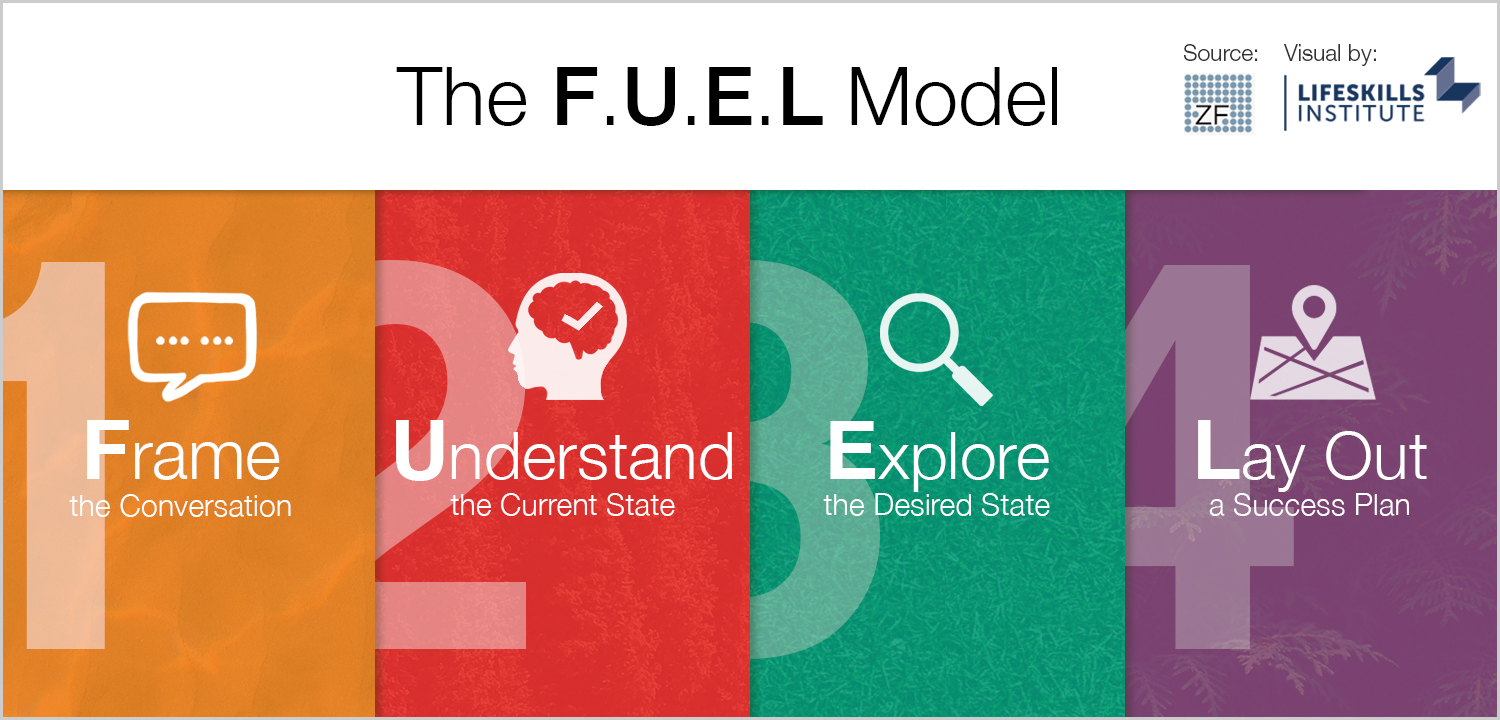
Here’s a quick review of the 4 steps of F.U.E.L:
Step 1: Frame the conversation
Step 2: Understand the current state
Step 3: Explore the Desired State
Step 4: Lay Out a Success Plan
Most people managers would jump in with solutions at step 2, Understand the Current State, instead of allowing the person receiving the feedback to expand his viewpoint on the issue. We naturally want to put on our advisory hat and resolve the issue ASAP and get on with the work.
We hope that by drawing out what a F.U.E.L framework feedback session looks like, you’ll be able to see the value in spending the right amount of time on the first two steps of the conversation. You may be surprised that the solutions in step 3 could be more than what you had thought it could be as step 2, if carefully employed, would have opened up the mind of the feedback receiver and you to be able to come up with more creative, efficient and targeted solutions.
©Published by Lifeskills Institute Malaysia
Lifeskills Institute is the strategic partner of Zenger Folkman for Singapore and Malaysia. Our Chief Enabling Officer, Ian Tan is a Master Facilitator certified by Zenger Folkman.
Zenger Folkman is a strengths-based leadership development company helping leaders elevate their people and organisations. Co-founders Dr. Jack Zenger and Dr. Joe Folkman utilise empirical data and behavioural evidence to help leaders become extraordinary.
[1]-Definition by Zenger Folkman
More From This Category
Wie sicher sind Einzahlungen im Betflare Casino wirklich?
Als erfahrener SEO-Kopiraityer mit über zehn Jahren Expertise im iGaming-Sektor untersuche ich heute die Sicherheit der Einzahlungen im casino betflare. Gerade bei Online-Casinos ist das Vertrauen in die Zahlungsabwicklung ein entscheidender Faktor. Spieler wollen...
Vinci Spin Casino Treueprogramme und ihre Vorteile für Kunden
Was macht Vinci Spin Casino besonders für treue Spieler? Als erfahrener SEO-Texter mit zehn Jahren im iGaming-Bereich sehe ich immer wieder, wie wichtig Treueprogramme für Online-Casinos sind. Vinci Spin hebt sich durch sein durchdachtes Loyalitätsprogramm hervor, das...
Roman Casino Plattform: Ein Blick hinter die Kulissen
Als erfahrener SEO-Kopiraityer mit einem Jahrzehnt Expertise im iGaming-Bereich biete ich Ihnen heute eine fundierte Analyse der Roman Casino Plattform - einem aufstrebenden Anbieter im deutschsprachigen Online-Casino-Markt. Werfen wir einen Blick hinter die Kulissen...
Fambet Casino Transaktionsgeschwindigkeit im Testbericht
Einleitung: Wer ist Fambet und warum zählt die Transaktionsgeschwindigkeit? Als erfahrener SEO-Kopiraüter mit zehn Jahren iGaming-Expertise habe ich das fambet casino genau unter die Lupe genommen. Gerade die Geschwindigkeit von Ein- und Auszahlungen ist ein...
Fambet Bonusbedingungen verständlich erklärt für neue Spieler
Was macht den Fambet Bonus für neue Spieler attraktiv? Als erfahrener SEO-Texter im iGaming weiß ich, wie wichtig klare und transparente Bonusbedingungen sind - gerade für Spieler, die neu in der Welt der Online-Casinos sind. Fambet bietet nicht nur eine vielfältige...
Welchen Einfluss haben Limits auf den Spielverlauf bei Winzter Casino
Als SEO-Kopirạyter mit zehnjähriger Erfahrung im iGaming-Bereich weiß ich, wie entscheidend die richtigen Limits für den Spielverlauf in einem Online-Casino sind. Winzter Casino ist dabei keine Ausnahme. Die Limits beeinflussen nicht nur die Spielstrategie, sondern...
Bewertung der Ice Casino Auszahlungsmethoden im Vergleich
Als SEO-Kopiraýtter mit zehn Jahren Erfahrung im iGaming-Bereich analysiere ich heute die Auszahlungsoptionen von Ice Casino. Für Spieler ist die Wahl der passenden Auszahlungsmethode entscheidend - sie beeinflusst nicht nur die Geschwindigkeit, sondern auch die...
Welche Gebühren fallen bei Lucky Trunk Casino für Transaktionen an?
Als erfahrener SEO-Kopiraýtër mit Fokus im iGaming-Bereich analysiere ich heute die Zahlungsgebühren des Lucky Trunk Casinos. Für viele Spieler sind die Kosten bei Ein- und Auszahlungen entscheidend, um die tatsächliche Rentabilität des Spielens einzuschätzen. Lucky...
King Billy Treueprogramm – Lohnt sich das für Stammspieler?
Als erfahrener SEO-Kopiraüter mit 10 Jahren Schwerpunkt im iGaming-Segment untersuche ich heute das King Billy Treueprogramm und seine tatsächlichen Vorteile für Stammspieler. Wer auf der Suche nach einem Casino mit nachhaltigen Belohnungen ist, sollte verstehen, wie...
0 Comments