
New employer data confirms that the skills organisations most need are the hardest ones to teach — and why the future of talent development depends on behavioural readiness, not technical qualifications.
The widest skills gaps facing organisations in 2026 are not where most leaders expect them.
According to the QS Global Employer Survey, employers place the highest value on teamwork and communication — yet report their biggest shortfalls in emotional intelligence, problem-solving, and resilience. The skills that matter most are precisely the ones in shortest supply.
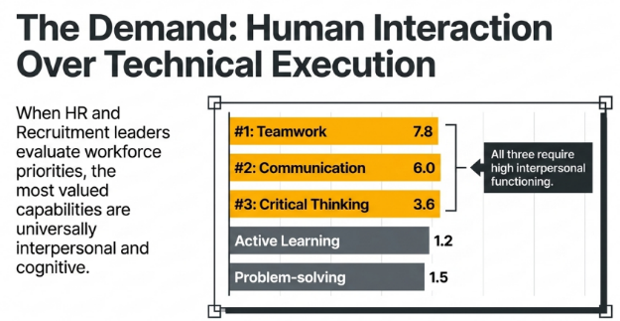
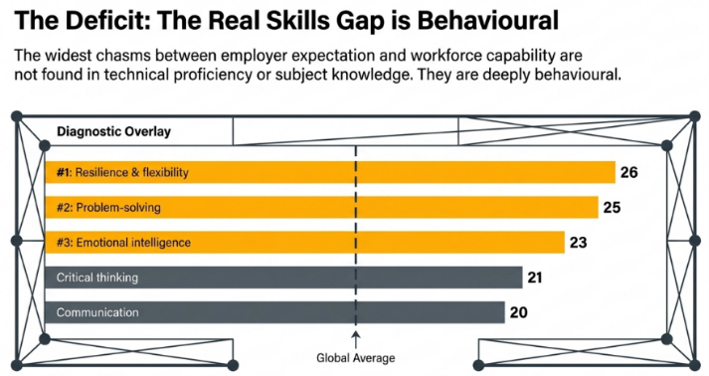
The message is clear. The competitive edge in 2026 no longer belongs to teams that are merely qualified. It belongs to those that are ready for reality — able to solve complex problems and operate within an EQ-driven leadership infrastructure. These are not gaps in knowledge. They are gaps in behaviour.
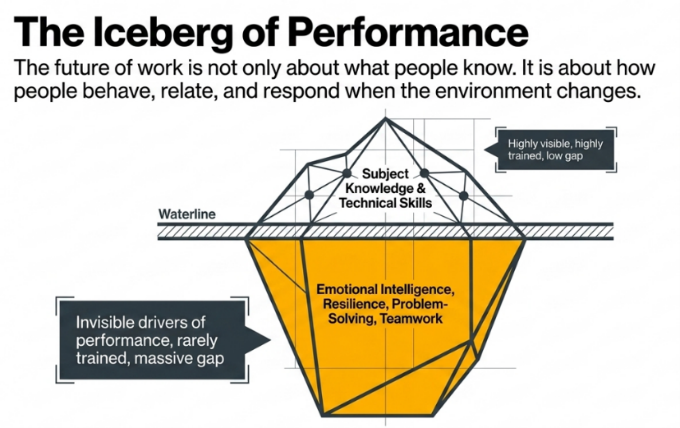
Why More Training Isn’t Closing the Gap
The modern workplace demands far more than technical qualifications. It demands behavioural readiness — the capacity to navigate digital transformation, hybrid work, and constant market shifts.
The QS data exposes the disconnect plainly: the “human” skills employers prize most are no longer optional extras. Emotional intelligence, problem-solving, and resilience are now the difference between a workforce that performs on paper and one that performs under pressure.
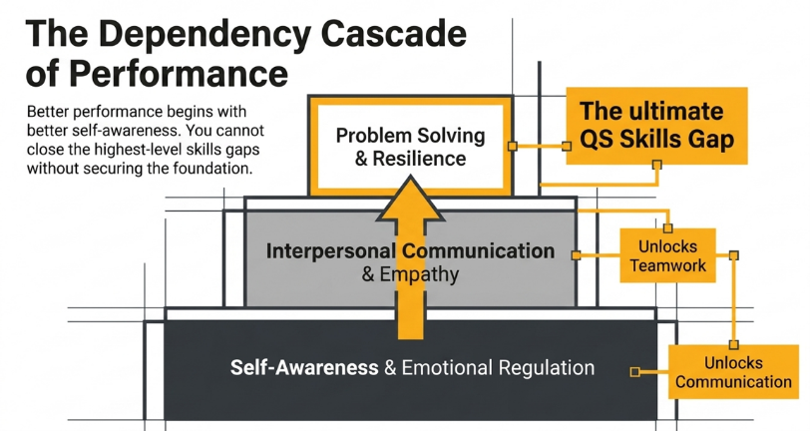
This is why another workshop rarely moves the needle. A qualification certifies what a person knows. It says little about how they behave when the conversation is hard, the deadline is real, and the team is under strain. Traditional training prepares people for a static role; the workplace they actually return to is anything but static.
From Attendance to Impact
Closing a behavioural gap requires a different approach to talent development — one measured by results, not activity. Three principles define that shift.
- Beyond activity-based training. Success should not be measured by the number of programmes delivered or participants enrolled, but by observable behaviour change in the workplace.
- Diagnosis before design. Effective development begins by identifying root causes — low trust, conflicting behavioural styles, unspoken tension — rather than treating symptoms with generic content.
- Practical application and reinforcement. Learning must transfer to real-world pressure, sustained by managers who reinforce new behaviours through coaching and feedback.
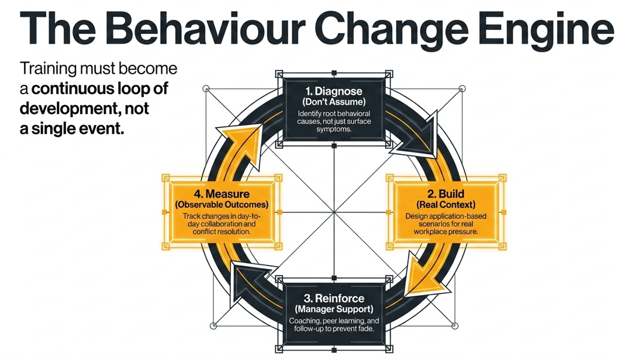
Together, these move an organisation from attendance — people passing through a training room — to impact: behaviour that holds up when it matters.
The Lifeskills Perspective
At Lifeskills Institute Malaysia, our approach to behavioural learning and talent development is grounded in self-awareness, communication, emotional intelligence, and practical application.
When individuals truly understand their own behavioural style — and the styles of those around them — they unlock the ability to build deeper trust, eliminate misunderstandings, navigate conflict, and collaborate with real efficiency. For organisations today, that capability is no longer a “nice-to-have.” It is a critical strategic advantage.
This is the foundation of our talent audit and assessment practice. Rather than beginning with a programme, we begin with evidence — a structured, multi-dimensional read of how your people actually behave, decide, and lead. That diagnosis is what turns development from a recurring cost into a measurable driver of performance and culture.
True development prepares people for reality — the reality of rapid change, high pressure, cross-functional collaboration, interpersonal conflict, and human complexity.
In a world where technical skills expire faster than ever, an organisation’s ultimate competitive edge lies in cultivating people who know how to learn, adapt, communicate, and lead themselves and others with excellence.
That is the true purpose of talent development. And it begins with knowing, precisely, where your people stand today.
Lifeskills Institute Malaysia is an HRDC-accredited talent development partner specialising in talent audit, multi-dimensional behavioural assessment, and evidence-led leadership development. To explore a talent audit for your organisation, contact our team.